The Rise of AI and Related Costs
In the last few years, AI has become a bit of a hot topic for companies and individuals alike, who think it will become the next big thing. As a result, many companies, including OpenAI, have spent billions of dollars building massive datacenters designed for running AI models. While these datacenters suffer from the same concerns as any other datacenter, there's a few more concerns here. With the combination of the AI boom in the last 6 months to a year, companies are buying out DRAM chips through 2027 and potentially beyond, with the intention of investing it all into AI. What will happen to all these components when the AI bubble eventually pops? Additionally, AI datacenters typically require more cooling and power than normal, due to the high numbers of GPUs.
The Race for Modern Hardware
While most datacenters cycle out physical servers every 5 years or so, AI datacenters are typically cycled out faster. This is due to the push to get the latest and greatest GPUs, since even stuff that is 2 or 3 years old is considered "not good enough" for modern AI models. This is problematic because while the servers being phased out are typically still powerful and useful, not many companies want them and most individuals cannot afford them and/or cannot use them. As a result, many of these servers are sitting around doing nothing while companies are spending millions trying to get their hands on the latest hardware. In addition, physical hard drives are beginning to be phased out of datacenters as the swap to much faster SSDs occurs. Most of these disks will be too worn for reliable consumer use, and will likely be destroyed and thrown out.
Heavy Demand on Local Infrastructure
As mentioned briefly above, AI datacenters typically require more power and cooling compared to other datacenters, due to the heavy reliance on GPUs. Servers loaded with GPUs tend to be much more power hungry compared to typical servers, leading to much more power consumption overall. In some areas, utility companies are struggling to keep consistent power for consumers, as heavy datacenter loads strain the network. On average, a single ChatGPT query will use about 10 times as much energy as a Google search.
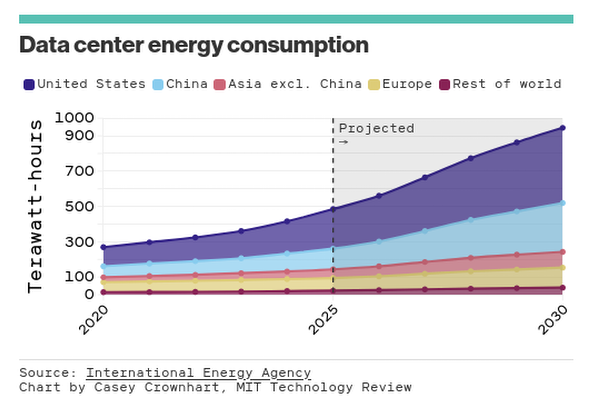
In addition, these AI datacenters use up large quantities of water to cool the hot GPUs. Typically, water will be pulled from the local grid, and evaporated into the atmosphere, so that more energy doesn't need to be expended cooling down said water. While this doesn't directly cause any pollution, datacenters built in drought-prone areas can further strain water supplies.
The AI Datacenter Fallout
While these huge AI datacenters are causing tons of problems today, there is another issue looming on the horizon. In the past when large waves of hardware have become sold, they could still be used for many tasks, and so were reused for cheap. However, this won't be the case with specialized AI servers. When the AI bubble inevitably pops, thousands upon thousands of these AI servers will no longer be needed. While some of these may be sold off, most will not, since they are almost useless unless someone is running large AI models. This may lead to large numbers of these servers being completely scrapped, creating a large wave of e-waste. These AI servers are often harder to recycle compared to other electronics as well, since they are precisely built for thermal management, making disassembly complicated.